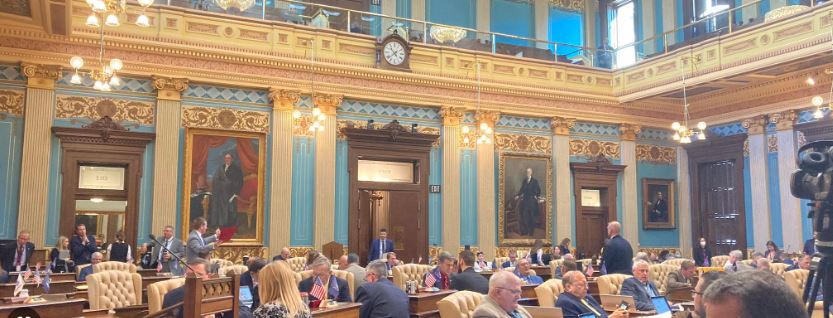
Michigan’s Attorney General issued a formal legal opinion declaring the House Appropriations Committee used an unconstitutional mechanism to cancel nearly $645 million in previously approved “work project” funding.
Dana Nessel’s Jan. 7, 2026 opinion is in response to the committee’s December 2025 action. Her opinion concluded the unilateral disapproval authority exercised by the committee violated both the separation of powers and the bicameralism and presentment requirements of the Michigan Constitution.
The issue centers around a Management and Budget Act provision that allows either the House or Senate Appropriations Committee to disapprove work-project designations made by the State Budget Director. The Republican-led House Appropriations Committee used that authority to halt the continued use of the $645 million that was enacted by the Legislature and signed into law.
While attorney general's opinions are not court rulings, they are binding on state agencies, unless a court overturns them. The effect is immediate and is a major reversal for House Republicans, who framed their action as essential to safeguard against unspent balances and “slush funds.” The opinion supports Senate Democrats and the administration, who argued the cuts undermined prior commitments to communities, nonprofits, and local governments.
Nessel's opinion reaffirms Governor Gretchen Whitmer’s executive authority over budget implementation, specifically when negotiations are more tenuous due to a divided government. With Whitmer in her last year in the governor’s office, a Republican-led House and a Democratic Senate, the year is less likely to be defined by sweeping legislation and more by sharp policy contrasts, strategic positioning, and disputes over process.
Education reform is emerging as the primary policy concern in 2026, but leaders disagree on the specifics of implementing those reforms. Leaders are expected to continue seeking improved literacy through early reading interventions, tutoring, and accountability tied to student outcomes. Improving third-grade reading proficiency and tackling post-pandemic learning loss are top priorities. Proposed changes to the school funding structure and transparency are anticipated.
Senate Democrats are expected to renew efforts to expand government transparency through public records access, including pushing for Freedom of Information Act (FOIA) requirements for the governor’s office and Legislature.
Property tax reform is likely to be a noteworthy issue due to inflation and cost-of-living. House leaders are focused on tax relief for homeowners and businesses, especially in communities with rapidly rising assessments. Democrats don’t dispute affordability concerns, but are concerned about reforms that could destabilize local government revenues or move costs to the state budget without long-term offsets.
Health care costs and workforce shortages are another issue leaders will likely address as the state grapples with an aging population and an insufficient number of workers in critical sectors.
Policymakers are expected to debate: tax relief versus fiscal stability, education outcomes versus funding structure, transparency versus operational concerns, and health care access versus cost control. However, how policy decisions are made is more significant than any one issue in 2026. As trust between chambers is diminished, it’s anticipated that the House and Senate will put emphasis on process, through committee authority, supplemental budgets, and statutory levers that can advance or block priorities without full legislative buy-in.
Click here for the complete January 2026 Karoub Report.