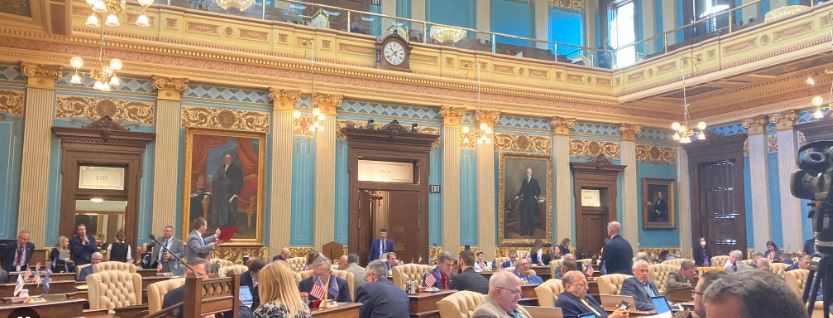
Gov. Gretchen Whitmer delivered her eighth and final State of the State address Feb. 25 before a joint session of the Michigan Legislature. The term-limited governor outlined three core priorities for 2026: literacy, housing, and health care affordability.
Noting that the state ranks 44th nationally in fourth-grade reading, her 2026 literacy push calls for continued investment in evidence-based reading instruction, early intervention programs, and after-school programming. Her plan includes continuing free PreK and universal school meals.
Appealing to legislative leaders to deliver a final balanced, bipartisan budget on time by June 30, she called for an accelerated push to build more housing statewide, pledging to align state resources to improve efficiency and reduce red tape hampering new construction.
With about 2.5 million Michiganders enrolled in Medicaid, proposed federal cuts could devastate coverage and destabilize rural and underserved hospitals, Whitmer said. Her FY2026-27 executive budget recommendation includes a significant investment to stabilize Medicaid funding. She also announced plans to help residents reduce medical debt and called on Congress to restore Affordable Care Act subsidies as many families face significantly higher premiums.
The Governor highlighted her successes over the past 7 years, including a $1 billion tax cut for seniors and working families; free school meals for all students; free community college; elimination of state taxes on retirement income, tips, overtime, and Social Security; record-level road repairs and replacement of lead pipes; and construction of thousands of new homes. For the first time since the early 1990s, she said, more people moved into Michigan than left.
There are competing state tax change proposals in the works. Whitmer proposes some $780 million in new revenue to help stabilize Medicaid funding. House Speaker Matt Hall (R-Richland Township) proposes what he describes as the most sweeping property tax and service tax restructuring proposal in modern Michigan history. Finally, a citizen-led ballot initiative is gathering support to place a 5 percent income surtax on high earners on the November ballot.
Governor Whitmer’s proposal includes:
- New 4.7 percent excise tax on digital advertising revenues attributable to Michigan users
- Increase Michigan's cigarette excise tax by $1 per pack (from $2 to $3)
- 57 percent wholesale tax on vaping products and nicotine pouches
- Increase the tax rate on internet casino gaming revenue above $185 million
- New per-wager fee on online sports betting platforms of $.25 cents per wager, for the first 20 million bets annually, and $.50 cents per wager above that threshold.
Speaker Hall’s tax restructuring plan combines major property tax reductions — estimated at roughly $5 billion — with a new sales tax on certain discretionary services expected to generate approximately $4.7 billion, producing a projected net tax reduction of roughly $275 million. The plan includes:
- Extending Michigan's 6 percent sales tax to selected discretionary services
- Repealing the 6-mill State Education Tax
- Repealing the real estate transfer tax
- Elimination of remaining business personal property taxes
- Changes to the taxable value “uncapping” rules on home sales
- Utility rate reductions tied to tax relief
The “Invest in MI Kids” Ballot Initiative is a citizen-initiated constitutional amendment that would impose a 5 percent surcharge on taxable income above $500,000 for single filers and $1 million for joint filers, in addition to Michigan's existing 4.25 percent flat income tax rate. To be placed on the ballot, 446,198 valid signatures will have to be submitted by July 6, 2026. The plan would bring in an estimated revenue of $1.5 billion to $1.7 billion annually for the school aid fund.
Also on the ballot this November is a deceptively simple question. Every 16 years, Michigan voters are asked: Should the state hold a constitutional convention? If a majority vote yes, delegates are elected the following year to draft proposed changes to Michigan’s Constitution. Any revisions they make do not automatically take effect, as the final document must be approved by voters in a statewide referendum. Advocates for a convention argue that Michigan’s constitution has grown increasingly complex after decades of amendments. A convention could allow the state to reconsider issues ranging from tax structure and education funding to the balance of authority between the Legislature and executive branch. Structural questions such as changes to legislative term limits; adjustments to the initiative and referendum process; or clarifying the roles of state and local governments could also be addressed. Opponents are concerned about the risks of opening the constitution to sweeping changes as delegates would have broad authority to propose revisions to virtually any part of the document. Critics argue this could cause uncertainty for public institutions, businesses, and taxpayers while the convention deliberates. Further, they note the existing amendment process already allows voters to make targeted changes without reopening the entire constitution.
With the entire Michigan House of Representatives and Senate on the November ballot, the constitutional convention question could become part of a broader conversation about the future direction of state government.
For complete details, click here for the March 2026 Karoub Report.