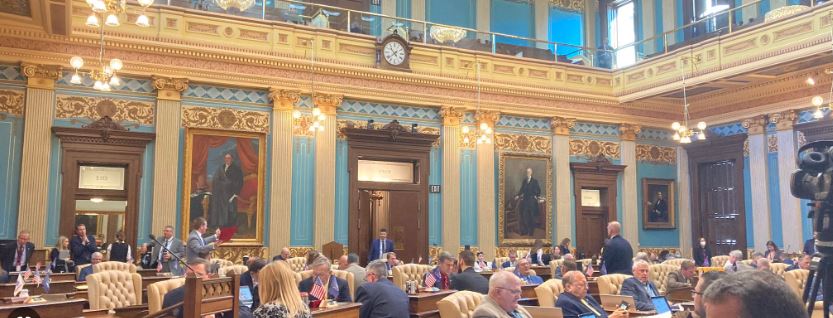
The Detroit Regional Chamber's annual Mackinac Policy Conference convened May 26–29 at the Grand Hotel, drawing lawmakers, business leaders, lobbyists, and policy advocates from around the state and nation. This year's theme — "A Quest for Common Ground" — focused on bipartisan solutions ahead of November's midterm elections. Conference Chair Bob Riney, CEO of Henry Ford Health, emphasized the need to move past partisan gridlock on issues important to Michiganders: education, economic growth, healthcare, and population retention.
During the conference, Governor Gretchen Whitmer signed legislation awarding $152 million for upgrades at Selfridge Air National Guard Base — which is anticipated to unlock $792 million in federal military construction funding. Whitmer told attendees she is not running for president in 2028, but later left the door open. A Democratic U.S. Senate primary debate between state Sen. Mallory McMorrow, Congresswoman Haley Stevens, and Dr. Abdul El-Sayed revealed sharp contrasts on tariffs, energy costs, and how Democrats can win back voters. Speaker Matt Hall floated a primary election reform proposal at the conference. There was a significant policy debate over university governance, with the Detroit Regional Chamber President Sandy Baruah citing a "crisis" in oversight at Michigan's three R1 research universities — U of M, MSU, and Wayne State. An MSU trustee publicly supporting abolishing the elected board model.
Former Detroit Mayor Mike Duggan elaborated on ending his independent campaign for Michigan governor, acknowledging his campaign was behind in polling and fundraising. His candidacy centered around a belief that years of Democratic-Republican conflict in Lansing had led to declining schools, rising housing costs, and young people leaving the state. By spring, Duggan pointed to a sudden shift in national mood, with Democrats and independents unified in frustration over the war in Iran and gas prices rising above $5 a gallon. This movement, he said, was consolidating voters behind partisan candidates.
On May 15, the Consensus Revenue Estimating Conference (CREC) finalized the state's official revenue projections for the current and upcoming fiscal years. While revenues are somewhat better than anticipated in January, State Budget Director Jen Flood said they were not sufficient to plug a budget hole in excess of $1 billion. Lawmakers have until July 1st to sign a balanced state budget.
Property tax relief has emerged as one of the defining policy debates of Michigan's 2026 legislative session, with House Republicans and Democrats releasing competing proposals this week that were significantly different in scope, cost, and who would benefit. The Republican package is titled HELP UP (HB 5872 through HB 5879) — Hall Effectively Lowering Property Taxes and Utility Payments. Speaker Matt Hall (R-Richland Township) said the plan would save the average taxpayer about $900 a year, plus $250 in utility bill savings. HB 5872 would eliminate the property tax "pop-up" that occurs when property is sold and taxable value is uncapped to 50 percent of market value. Taxable value would remain capped post-sale, limiting increases to inflation or 5 percent, whichever is less. HB 5873 would repeal the six-mill State Education Tax, reducing School Aid Fund (SAF) revenue by a House Fiscal Agency estimated $3.1 billion in FY 2027 and $3.2 billion in FY 2028. HB 5874 would repeal the real estate transfer tax, at an estimated SAF cost of $475 million in FY 2027 and $488.3 million in FY 2028. HB 5878 and HB 5879 exempt remaining personal property from personal property taxes starting in 2027 and requires utilities to pass resulting savings on to residential ratepayers through the Michigan Public Service Commission — while prohibiting utilities from filing a general rate case for two years after a rate decrease order is issued.
The Democratic plan would benefit households earning under $100,000 annually, retirees living on fixed incomes, renters, and first-time homebuyers. Instead of eliminating the pop-up, the Democratic proposal phases in the post-sale tax increase over three years and requires buyers to be made aware of their future tax obligations at the point of listing. The package would waive property tax increases tied to home renovations valued at up to $100,000. Its centerpiece is an expanded Homestead Property Tax Credit that Democrats say would reach approximately 900,000 additional households — including roughly 1.09 million renters — at an average annual benefit of $1,000. The estimated $330 million cost would be offset by a graduated excise tax on non-primary residences valued above $1 million, starting at 2 percent and increasing for properties valued above $2 million, $3 million, and $4 million. Standing with House Democrats, education policy advocates expressed concern about broad-based cuts to property tax collections that would put considerable pressure on school funding, police, libraries, and local infrastructure.
The Michigan Supreme Court heard arguments in May regarding nine bills passed by both chambers in December 2024, but never transmitted to Governor Whitmer. The bills would place corrections officers in the state police pension system, require public employers to cover a larger share of employee health care premiums, exempt public assistance from debt collection, and allow Detroit historical museums to propose a millage.
During a May House Government Operations Committee hearing, a bipartisan group of local elected officials turned out in opposition of the Housing Readiness Plan, which would update Michigan's zoning laws to address housing affordability, including preventing local governments from blocking construction of duplexes. Opponents said the legislation strips too much local control.
Under H.R. 1, Michigan's Department of Health and Human Services must implement new federal mandates for most Medicaid recipients to work 80 hours per month to qualify for benefits, and to reapply every six months rather than annually. MDHHS Director Elizabeth Hertel estimated that hundreds of thousands of Michigan residents could lose coverage over the next several years as a result.
For complete details, click here to read the June 2026 Karoub Report.